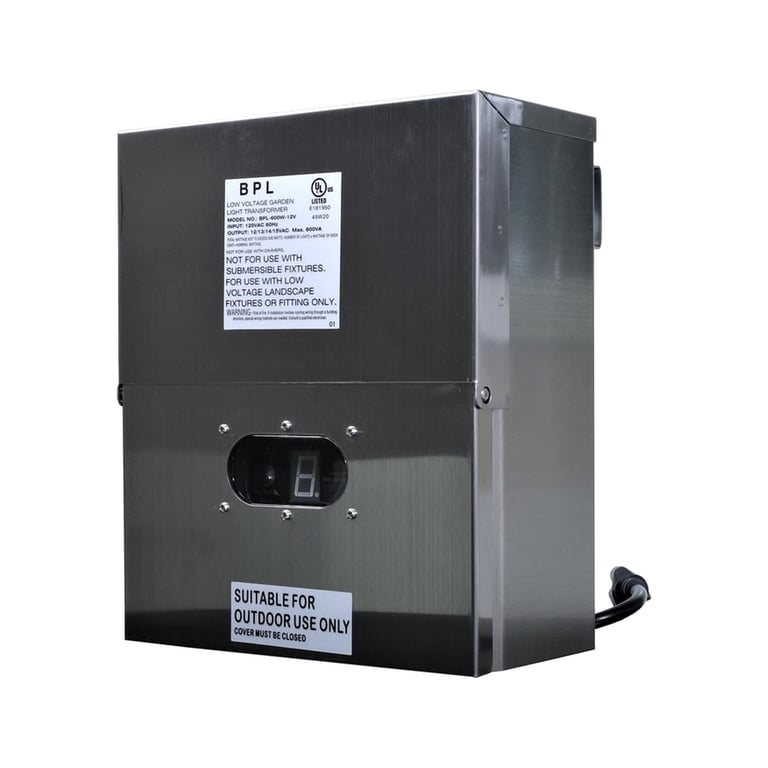
Low Voltage Transformers for Landscape Lighting
A reliable low voltage transformer is the power source behind a well-planned landscape lighting system. It converts standard household power into the lower voltage required by compatible outdoor fixtures, allowing you to illuminate walkways, garden beds, trees, patios, and architectural details from a central power source.
Best Pro Lighting offers outdoor lighting transformers in 60W, 150W, 300W, and 600W capacities. The selection includes 12V models and multi-tap transformers with 12V to 15V outputs for projects that need more flexibility. Whether you are replacing an existing unit or building a new lighting system, the best low voltage transformer is one that matches your connected lights, total wattage, cable layout, and preferred controls.
Compare the transformer sizes and installation considerations below.
How to Choose the Best Low Voltage Transformer
A high wattage rating does not automatically make a transformer the best choice. For outdoor landscape lighting, proper sizing and electrical compatibility are more important than buying the largest model available. List your fixtures, their wattage, and required output voltage before comparing models.
1. Calculate Your Total Landscape Lighting Wattage
Add the wattage of every light connected to the transformer. Best Pro Lighting's sizing guidance recommends planning for a connected load of no more than approximately 80% of the transformer's maximum rating. This provides operating headroom.
- 60W transformer: approximately 48W of planned connected load.
- 150W transformer: approximately 120W of planned connected load.
- 300W transformer: approximately 240W of planned connected load.
- 600W transformer: approximately 480W of planned connected load.
For example, seven landscape lights using 20W each create a total load of 140W. Under the 80% planning guideline, a 150W unit would not leave enough headroom, so a 300W transformer would be a more suitable option. The actual fixture count depends on wattage, not simply the number of lights.
2. Check the Output Voltage and AC or DC Requirements
Most low voltage landscape lighting shoppers are looking for a 12V outdoor lighting transformer, but voltage alone does not tell the whole story. Some lights require AC power while others are designed for DC, and not every LED bulb or fixture supports both. Match the output type and voltage to the specifications of the lights you intend to connect.
Best Pro Lighting offers different transformer configurations, including the 60W 120V AC to 12V DC Outdoor Low Voltage Transformer. Check product specifications before replacing an existing unit.
3. Account for Cable Length and Voltage Drop
Voltage drop occurs as electricity travels through landscape lighting cable. Longer wire runs, higher current, and wire size can affect the voltage that reaches the fixtures. Distant lights may receive less voltage than nearby lights.
For projects where additional output choices are appropriate, a multi-tap landscape lighting transformer provides more flexibility than a single-output model. Best Pro Lighting has 300W and 600W multi-tap models with 12V, 13V, 14V, and 15V outputs. The correct tap should be chosen for the actual circuit and compatible fixtures, rather than assuming that a higher voltage is always better.
4. Compare Timer and Photocell Controls
Think about when you want your outdoor lights to operate. Depending on the model, transformer controls may include a timer, photocell, dusk-to-dawn operation, or constant-on setting. A timer can follow a chosen schedule, while a photocell responds to changing ambient light. Check each product page for its available controls.
Choose controls that match when you want the lights to operate.
Outdoor Low Voltage Transformer Options from Best Pro Lighting
A small path lighting project and a larger property-wide installation may require very different transformer capacities. Best Pro Lighting currently carries the following options for different lighting loads and layouts:
Select stainless steel models provide a different housing option from the black metal case transformer. Compare housing materials, output type, wattage, mounting requirements, and included controls for each product rather than assuming every transformer has the same construction or internal components.
What Does a Low Voltage Landscape Lighting Transformer Do?
A landscape lighting transformer reduces incoming line voltage to a lower output that compatible landscape lights can use. In a typical residential application, the household supply is 120V, while many outdoor lighting fixtures are designed for 12V systems. The transformer makes it possible to use these lower-voltage fixtures without connecting them directly to household line voltage.
Low voltage lighting is commonly used to mark walking routes, illuminate garden features, and draw attention to areas of a property after dark. A system may combine path and area lights, directional lights, and other compatible fixtures. Match the transformer to the lighting layout and load.
Using low voltage equipment does not eliminate the need for correct installation. The transformer must be suitable for its intended location and installed according to its instructions and applicable electrical requirements. Electrical work involving line voltage should be handled by a qualified professional when required.
12V Transformers vs. 12V to 15V Multi-Tap Transformers
A single-output 12V transformer is a straightforward choice when the fixtures are compatible and the planned cable layout can deliver suitable voltage to each light. Multi-tap models add selectable outputs, often 12V, 13V, 14V, and 15V. These additional taps may help an installer address voltage loss on certain longer circuits.
For example, a landscape might have one group of lights close to the transformer and another farther along a cable run. Depending on the load and wiring, the two groups may have different voltage-drop conditions. A multi-tap model provides more choices, but the correct selection still requires checking the fixture voltage range and circuit conditions. Proper cable selection and layout still matter.
Compare the 300W multi-tap transformer and 600W multi-tap transformer if selectable voltage outputs are part of your installation plan.
How Many Landscape Lights Can One Transformer Power?
The answer depends on the wattage of the individual lights. Ten 3W fixtures draw 30W in total, while ten 12W fixtures draw 120W. Both layouts use ten lights, but their transformer requirements are very different. This is why a landscape lighting transformer should be selected using total load rather than fixture count alone.
When fixtures use different wattages, calculate each group separately and add the totals. Remember to count every bulb or integrated fixture that shares the transformer. If you expect to extend your landscape lighting later, account for the additional wattage before choosing the transformer size.
Extra transformer capacity does not correct voltage drop. Cable routing, wire size, and tap selection matter independently of total wattage.
Planning a Low Voltage Outdoor Lighting Installation
Before purchasing an outdoor low voltage transformer, sketch where you want the lights to go and note the approximate cable routes. Start with the areas that benefit most from illumination, such as entrances, walkways, planting beds, and gathering spaces. Then decide how many fixtures are needed in each area and what type of lighting effect you want.
The layout will help you decide whether one central transformer is practical for the project and whether longer runs need extra attention. It also makes it easier to estimate total wattage accurately. For example, a design that combines LED garden lighting with step and deck lights should account for the requirements of both groups.
Keep the transformer accessible for inspection and any adjustments allowed by its instructions. Check mounting, ventilation, weather exposure, and permitted installation location for the specific model. If you are unsure about the electrical supply or wiring requirements, consult a qualified installer before connecting the equipment.
AC and DC Compatibility for LED Landscape Lighting
LED lighting makes low voltage transformers an important part of many outdoor lighting projects, but compatibility should never be assumed from the word "LED" alone. Some low voltage LED products accept both 12V AC and 12V DC; others have more specific requirements. The transformer must supply the appropriate output for the fixture or bulb.
If you are replacing an older transformer, check the label on the existing unit and the specifications of the connected lights. Confirm whether the existing system uses AC or DC, record its output voltage, and calculate the actual lighting load. This also applies when upgrading bulbs but keeping older fixtures. A replacement should be selected for the lights you currently use, not just because its wattage matches the previous transformer.
What to Check When an Outdoor Lighting Transformer Is Not Working
If your landscape lights do not turn on, the transformer is not necessarily the cause. A timer setting, photocell condition, power supply interruption, wiring problem, or incompatible fixture can also affect operation. Begin with the basic checks described in the product instructions, including the selected operating mode and whether the connected lights are meant to be on at that time.
Unusual buzzing, excessive heat, visible damage, a burning smell, or repeated interruptions can indicate a problem that needs professional attention. Stop using a transformer that appears damaged, and do not attempt to repair internal electrical components yourself. A qualified technician can determine whether the transformer or another part of the lighting system needs service.
For routine care, keep the installation accessible and follow the manufacturer's inspection and maintenance instructions. Avoid blocked ventilation or conditions outside the model's permitted installation environment. Regular checks can help you notice damage or connection issues before they affect the rest of the outdoor lighting system.
Why Buy Landscape Lighting Transformers from Best Pro Lighting?
Best Pro Lighting offers a focused range of low voltage outdoor lighting transformers for different wattage needs, including single-output and multi-tap options. Compare the wattage, outputs, and features needed for your system.
The company also lists a lifetime warranty for transformers, subject to its published terms and exclusions. Before ordering, review the warranty alongside the product specifications so you understand the coverage and the installation requirements associated with your purchase.
Whether you need a 60W 12V lighting transformer for a modest setup or a 600W multi-tap model for a larger design, choosing the right unit is easier when you know the connected wattage, output requirements, and cable layout. Best Pro Lighting also carries landscape lighting kits if you are planning a more complete project.
Shop the Best Low Voltage Transformer for Your Project
Start by calculating your total wattage, then compare 12V and multi-tap options with the voltage requirements of your outdoor lights. Consider whether you need a timer or photocell, how far the cable runs will extend, and the installation location. Choose a model suited to those requirements.
Browse Best Pro Lighting's current selection of outdoor lighting transformers, read the individual product details, and select the capacity that suits your landscape lighting plan. For questions about product selection, visit the Best Pro Lighting contact page before placing your order.
Low Voltage Transformer FAQs
What is the best low voltage transformer for landscape lighting?
The best model matches the combined wattage of your fixtures, their AC or DC requirements, cable length, and desired controls. A high-wattage transformer is not automatically the right option for a smaller lighting system.
What size low voltage transformer do I need?
Add the wattage of all connected lights and choose a transformer that offers adequate operating headroom. Best Pro Lighting recommends planning around a load of no more than approximately 80% of the transformer's maximum rating.
Can I use a 12V transformer with LED landscape lights?
Yes, if the transformer and LED fixtures are compatible. Check voltage, AC or DC output, and any other electrical requirements specified by the lighting manufacturer before making the connection.
What is a multi-tap landscape lighting transformer?
A multi-tap transformer offers several selectable voltage outputs, such as 12V, 13V, 14V, and 15V. The extra taps can help address voltage drop on certain cable runs when the system is designed and installed appropriately.
Do low voltage lighting transformers include timers or photocells?
Some models include timer, photocell, dusk-to-dawn, or constant-on settings. Controls vary by transformer, so check the specific product description before purchasing.